Sunday, September 25, 2016

The Game (and the Interview) Gives Way to Something More Important

MIAMI - Something that was started with promise, ended up being up in the air. But unfortunately, that was not the worst of it....far from it. It sounded so simple, take a redeye across the country, arrive in Miami by 8 a.m. before checking in and asking my baseball idol Ichiro Suzuki a few questions while also possibly telling him he was being inducted into the Wing Luke Museum's Sports Hall of Fame.
However, once on the plane, a fellow passenger fell ill and we diverted to Dallas to get her to the hospital. After a two-hour delay, we finally arrived at 10:10.-The time I was supposed to be at Marlins Park.
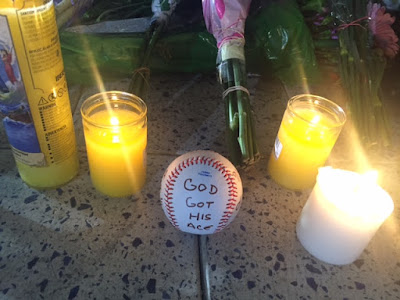
Going through the maze of the Miami airport it's more like a labyrinth especially with the rental car. Bu the time I got out of there and drove up to Marlins Park, it was 11:30 a.m.- about 90 minutes before the first pitch wold be thrown. Under the time was "GAME CANCELLED" shined brightly accompanied by another lighted sign "Jose Fernandez 16". Seeing that, this great feeling of dread overcame me.  
I held out hope that was just his name up there for being National League pitcher of the week or something like that. None such look. That's when my friend Nobu, a Japanese journalist, told me what really happened, he and two friends had perished in a boating accident at a nearby jetty late last evening.
I was floored. Here I was going across the country to do something I had been looking forward to doing for quite some time, and then not only realizing that it was not going to happen, but exponentially worse, one of my favorites pitchers, a kid who defected to the U.S at the age of 15. after three previous unsuccessful attempts and then becomes one of the most talented pitchers and entertaining spirits out there...after Tommy John surgery, had died in a boating accident at the still young age of 24.
Even when he's not pitching Jose Fernandez commands attention. (Taking on Jun 14 in San Diego)
I've only met Jose in passing, but I got to see how he acted with his brothers, his teammates. There was no better teammate. At the press conference announcing his death, the entire team of players and coaches were wearing their black jerseys in a show of solidarity for their fallen teammate. There was no game, only tears coming from teammates like Yelich, Prado and Gordon, the Marlins announcing team, coaches like Lenny Harris and yes, his manager Don Mattingly along with team president Michael Hill who were all deeply affected. A few even came from the normally jaded media side. I'm not ashamed to admit that I was in that group.
Outside the media room, instead of fans happily filling the stadium to honor the great Ichiro, a few dozens who bought special tickets that included a commemorative Ichiro 3000-hit baseball bat peacefully queued up to pick up their prize. Some teens quietly played catch. Others came to the team shop to buy Fernandez and Ichiro shirts.
But instead of cheers and banter inside the store, there was a respectful murmur of muted conversations and staring at the television screen tuned into the MLB Channel. It reminded me of the day after September 11 2001, a day in which I was supposed to see Ichiro play for the first time, became a day of mourning. On September 12, wanting to get away from the television, my wife and I just drove and drove, until we ended up at Universal City Walk of all places. It was deserted, save a few zombies like us. I came across a Japanese family, that was supposed to have flown back home that day, but obviously couldn't. The little boy noticed my shirt and yelled "Ichiro!" We had a good laugh over that one, but our smile soon faded as the reality was too close in everyone's memories.
Later tonight, I went back to Marlins Park and the place was teeming with people, old and young, white, black and of course Fernandez's fellow Cubans. Television cameras were still there, the pile of flowers had doubled in size, and people were still bringing bouquets. Kids were playing, but not noisily-it was as if they recognized the gravity of the situation.
While it appeared to be business as usual around the city, there was a large group of people who were deeply affected enough to want to show their respect. It was announced earlier that the day's next game against the Mets, would go on as planned. Not even death can get in the way of a wildcard race New York is in the thick of, and the Marlins are barely holding onto. I continued to make plans for my potential interview, fully realizing that Ichi, anyone would really rather not talk to a reporter. If that reluctance shows on his face tomorrow, I'm not going to push the issue - my longtime desire to have this chance notwithstanding, some things just aren't that important when it comes to loss of life.
Above everyone, the bright orange lettering continued to blare "Game Canceled" hours after the game would have ended, staying up to be more of a metaphorical reminder that the lives of Fernandez and two of his friends were snuffed out. Tomorrow the sign will be gone-which is another reminder to us that life does indeed go on.

Friday, May 1, 2015

The Impermanence of All Things Teaches Us That Joy Needs to Be Savored

The mood of the room and the field, belied my emotions this morning. Surrounded by NBA players present and future, as well as Olympic hopefuls, the banter was jovial. Players like Frank the Tank of Wisconsin, Oregon's Joseph Young, and Arizona phenom Stanley Johnson, all waiting for yoga class to begin, were easily zinging putdowns, jokes and friendly talk to anyone and everyone. Hours later, on the field of Pershing Park, a place where the mighty Babe Ruth once hit a home run, an exciting baseball playoff game was being played. The home team, the Santa Barbara City College Vaqueros were joyfully playing out an eventual 5-0 win over the Rio Hondo College Roadrunners.
it was great to be a fly on the wall of both atmospheres. Because it helped me to momentarily forget what I experienced the previous two days. Spending both days looking for a young man that would later be found death, was as traumatic an experience as I want to experience for now, was a grueling grind.
t was a frustrating few days prior, especially for his family. Yet there was still hope that Cody could be found alive. We all felt that way. Watching the helicopter fly above me on a trail between East Camino Cielo and Paradise Road on Thursday, I had a belief that somehow there was a chance...albeit slight. When hearing of the news it was like a punch in the gut, and then utter sadness for the family I have never met. Tonight, after it all been cleared away, I went to the spot trying to fathom why a young life full of promise was suddenly over. The only solace I had was to accept the impermanence of all things. And then eventually I smile, remembering the other occurrences of the previous two days.

Wednesday, April 15, 2015

The Man Who Should Have Gotten Some Credit for Baseball's Integration, But Didn't


By Michael Goro Takeuchi

Lester Rodney, one of the first journalists to call for the end of segregation in baseball.


   "I ain't gonna play with no n---"  

Brooklyn Dodgers player Carl Furillo in 1946  prior to meeting Jackie Robinson

If there is a heaven, I'm hoping that Lester Rodney is sitting next to Jackie Robinson and Wendell Smith eating a hot dog and smiling down upon Dodger Stadium enjoying watching all the 42's run around the field.  Because God knows, he enjoyed it from the press box...and although uncredited, he played a part in it.
  Rodney, who died in 2009, was one of the first journalists to decry the unwritten but very much in existence rule of segregation in baseball starting in 1936, 11 years before Robinson played his first game for the Brooklyn Dodgers.  He, along with black journalists like Wendell Smith of the Pittsburgh Courier, would shout out in print that players like Josh Gibson and Satchel Paige should get there due.  And when Robinson became known,  he became Mr. Rodney's personal crusade.
   However Rodney, a WWII veteran in the South Pacific, was until a few years ago, a mere footnote in the books about Branch Rickey because he was rarely acknowledged due to one factor, the publication that he worked for was the Communist paper, the Daily Worker.  Although it may be difficult to comprehend in this modern age and political climate, but during the Great Depression the Daily Worker was one of most widely read publication in this country.
  Rodney, who was an unemployed college graduate, wrote to the Daily Worker complaining about its lack of sports coverage.   Tiring of this harangue, the editor promptly hired him as the publication's first editor.   The sports page was just like any other, covering sports and writing feature stories.  But it also included commentary about the social impact of sports. His bent caught the attention of one entity, only it wasn't MLB.  It was the FBI.  According to this "Forbes" article (http://www.forbes.com/sites/williampbarrett/2010/12/23/fbi-kept-tabs-for-decades-on-press-box-red/), Rodney was on the "watch list", even getting the attention of J. Edgar Hoover himself.  In fact, unbeknownst to him, Rodney was mentioned in Hoover's book "Master's of Deceit".   His typewriter was considered lethal by the government.
  It was from behind this typewriter that Rodney began to campaign for the integration of baseball.
  In an interview with him several years ago,  Rodney said this.
  "Blacks were denied the right to compete with and against the 'best Major League players'. Here were these wonderful players like Josh 'Hoot' Gibson, Buck Leonard and later, Satchel Paige.  This was a terrible wrong that needed to be righted." 
  Starting in 1936, Decade began waging a virtually one-man decade-long campaign by getting players and managers to speak out against segregation.  He called out baseball's Commissioner Judge Kennesaw Mountain Landis and many others.  The actions of Rodney, Smith and others were instrumental in Dodger president Branch Rickey's signing of Robinson to a minor league contract in 1946.  A year later, he would be promoted to the Dodgers.
  Rickey, a staunch anti-communist, refused to credit Rodney and the Daily Worker in playing any role.
  "It didn't matter who got the credit, because we just wanted to end the f--- ban," Rodney said.
 As a regular writer covering the Yankees, Dodgers and Giants, Rodney was "privileged" to cover many players like Joe DiMaggio, Mickey Mantle and Willie Mays.  Rodney was covering the game when Mays made his famous catch off the bat of Vic Wertz in the 1954 World Series (http://m.mlb.com/video/topic/6479266/v3218956/bb-moments-54-ws-gm-1-willie-mays-amazing-catch).
   "I just remember in the press box everyone going 'whoo!" Rodney said with a laugh.  "There was almost a breach of protocol (of no cheering) in the press box."
  Rodney, who was featured in a 2010 ESPN "Outside the Lines" episode,  also was privy to some private moments that were equally memorable.  One occurred in 1947 shortly after it was announced that Robinson was promoted from the Dodgers farm team, the Montreal Royals, to the Big League club.  Some of the members of the Dodgers were none too happy that "a negro" would be joining them.  Among those voicing their displeasure were Dixie Walker, who was particularly against Robinson joining him.  Others expressed themselves as well, including outfielder Carl Furillo who uttered something within Rodney's earshot.
   "I ain't going to play with no niggers," Furillo said.
  "Carl wasn't as vocal as some of the others, especially some of the players from the South.  He was just a kid from a coal mining town in Pennsylvania who didn't know any better." 
 Eight years later, after the Dodgers finally defeated the Yankees in the 1955 World Series, was Furillo, joyfully dancing cheek-to-cheek with Robinson at the team's victory party.
  "That one moment spoke more to be about the change of a man's attitudes more than any words could."
  Another memorable time came during a game against the St. Louis Cardinals.  Rodney decided to walk around the concourse of Sportsman's Park when he came across an exchange between a Black fan and a white fan.  Robinson had just gotten a hit, when the Black fan stood up and started cheering.
  "The white fan said 'Hey pal, what's the big deal rooting against the Cardinals?  They're the home team.'  The Black guy rolls his sleeve up and points to his arm and says "Once the Cardinals gets one of these, I'll root for them.  But today I'm cheering for the Dodgers." 
  For an afternoon in Walnut Creek, Lester Rodney delighted my wife and I with story after story about the golden age of baseball.  It was something that I won't soon forget.   And he is someone I won't ever forget.

*Note Although he was never an official member of the Communist Party, Rodney had leftist leanings.  His attitude changed around the time of the Soviet Union's invasion of Hungary in 1956 when he became aware of Stalin's methods,  After leaving the paper, he moved West to become the religion editor for the Long Beach Press Telegram. Ironic, considering he was an atheist in his previous job.


For more information I recommend reading Irwin Silber's book, "Press Box Red".

Below is an article I wrote on Jackie Robinson Day in 2007.

Sports 

Home » Sports 
Email StoryPrint Story

A Tribute to Jackie Robinson 

MIKE TAKEUCHI, 
Locally and afar, Jackie Robinson's impact on baseball and beyond is remembered. Today's commemoration of the 60th anniversary of Robinson's debut in the Major Leagues will be celebrated across the country.
Dodger Stadium will be the focal point of all of the festivities. Led by Robinson's widow, Rachel, and MLB Commissioner Bud Selig, the Los Angeles event will include Hall of Famers Hank Aaron and Frank Robinson throwing out the first pitch, Academy Award winning actress Jennifer Hudson singing the National Anthem, and several distinguished guest speakers.
About 275 miles and one level away, a former resident will honor his legacy in his own way. Las Vegas 51s (the Dodger Triple-A affiliate) and former SBCC outfielder Delwyn Young played as a September call-up for the parent club. The holder of numerous school and Santa Barbara Foresters records, Young grew up in Los Angeles and is "extremely pleased" that someone he heard so much about is getting his due.
"A player of his caliber, and more importantly a man of his caliber should at be able to get at least one day in his honor," Young said by telephone. "If it wasn't for him, a lot of us African Americans wouldn't be playing today."
Jeff Idleson, the vice president of communications for the National Baseball Hall of Fame, said that his legacy extends beyond the field.
"Nobody has had a greater impact on changing the face of baseball than Jackie Robinson," Idleson said. "He single-handedly helped to destroy the building blocks of segregation, not only in baseball but in American society. Robinson's strong character, energizing style of play and ability to stand tall in the face of adversity benefited baseball, which with inclusion was a much stronger sport with better athletes, and benefited America, which in many ways, learned from baseball how to integrate society."
Retired journalist and former Santa Barbara Open age group tennis champion Lester Rodney, once the sports editor for the Communist Party newspaper The Daily Worker, said that this was no understatement. At the time, Rodney was a regular Dodgers beat writer for the first paper to decry its segregation 10 years prior to Robinson's debut.
"Campy (Dodger catcher Roy Campanella) used to tell me all of the time that they were the first -- the first to eat at restaurants, the first in certain hotels, the first to swim pools -- and he was right," Rodney said. "They began to turn the whole country. I remember the Dodgers were playing the Cardinals in St. Louis and this fan was being chided for rooting for the Dodgers. The guy pointed to his black skin and said once the Cardinals had one of these on the team, he would root for them again."
According to UCSB Black Studies professor Clyde Woods, the impact was felt beyond the diamond. Woods, who grew up rooting for Frank Robinson and the Baltimore Orioles, specializes in urban history and popular culture. He said that Robinson responded incredibly despite knowing the risks for his race in baseball and beyond.
"At the time there were three views in this country: those who wanted the barriers maintained, those who wanted them to come down, and still those who didn't believe they existed," Woods explained. "Baseball was a national sport with a tremendous profile during this era. And because of this, he was thrust into the fulcrum where his role was as much political figure and leader as baseball player, and became someone that all audiences could identify with, trust, and ultimately admire."
Today Robinson is paid tribute by a generation that never saw him play. Sparked by Ken Griffey Jr.'s request, several individuals and six entire teams, including the Dodgers, will wear the number 42. Young has also expressed a desire to wear it. He says it is not only for Robinson, but for his family -- particularly his grandfather Fate.
"Growing up in Los Angeles, my clearest memories growing up are going to the stadium and seeing my grandfather listening to the game on the radio," Young said. "I want to honor that family memory while paying tribute to a man I owe a lot to, Jackie Robinson."


Tuesday, June 4, 2013

And His Mountains Echoed-Writer Khaled Hosseini on Story

By Mike Takeuchi

Previously published article. (Book Review Below) 


  In his 48 years on this earth, writer Khaled Hosseini has already lived a life worthy of the novels he has penned.  And from the time he was a young child in Kabul Afghanistan, through a family move to Paris, subsequent political asylum and citizenship in the U.S. a year after the Soviet invasion of his country, and eventually a successful medical practice before a prolific literary career, the two constants in his life have been family and the stories that have accompanied it.
   And now, following his publishing of the 2003 novel The Kite Runner an international bestseller that was adapted into a feature film as well as another bestseller 2007s  A Thousand Splendid Suns, Riverhead Publishing has recently released his third piece of fiction And the Mountains Echoed-a multi-generational family saga that spans generations of people whose locations parallel his own path. The story begins in Afghanistan, the same place he learned the wonders of story as a child as Mr. Hosseini fondly recalled. 

AND THE MOUNTAINS ECHOED BY KHALED HOSSEINI
RIVERHEAD BOOKS


    There were a number of really good storytellers from my childhood, but my grandmother was the most consistent one, Mr. Hosseini said. She was very good at telling them whether they were completely made up with creatures like the div in the opening chapter of this novel or (they were) us experiences from her childhood like the time she went to Mecca with her mother when she was a little girl.  Maybe it was my personal bias and I am blinded by nostalgia, but I thought they were the best because she was a ready storyteller and I had a willing ear to take in those stories.
   From those tales, a young storyteller developed his own craft.
When I was a kid I remember very distinctly the parties we would have two or three times a week, he said. Our families socialized a great deal and we always had no fewer than 10 kids around.  One of the games we used to play was to sit around the room and each person would have to get up and tell a story.  And either it was good and people would ask them to continue, or it was bad and they would stop.
  I guess I was good because I remember when it was my turn I always felt a kind of hush descended on the room and it seemed like people were really tuned in, Mr. Hosseini said. That was sort of one of the first times I noticed that I really enjoyed that effect of telling a story and have somebody pay attention. So I started writing them down when I was 9 or 10-years-old.
  Years later, the author inserted one of his childhood stories it into his first novel The Kite Runner .In the novel, Amir, a young Afghan boy tells his best friend Hassan a story of a poor, but happy man who found a magic cup that makes him rich provided he could produce tears.   Greed eventually overcomes the man and he eventually tragically loses all that is important to him.
  Throughout his young life while attending high school and Santa Clara University  in Northern California, the author continued to write up until he attended medical school at the UC San Diego where the demands of his training forced him to stop.  It wasnt until he started practicing internal medicine in 1996 that he resumed writing.
  A year-and-a-half after the release of The Kite Runner, which by then was in the midst of spending 101 weeks on the bestseller list (four weeks at the top spot), the physician left his  practice to write full time.  In 2007, Riverhead published A Thousand Splendid Suns a novel that came from a female perspective that also spent weeks on the bestseller lists and has been adapted into a film scheduled to be released in 2015.
  While on that tour as well as acting as a Goodwill Envoy for the United Nations High Commissioner for Refugees (UNHCR) through his own foundation, Mr. Hosseini traveled to Afghanistan and was struck by a scene of a father towing two young children in a Radio Flyer red wagon.


  “I was waiting for an idea that just kind of hit me and this thing happened with the man in the desert,” he said.  
  What followed was a six-year process of trial and error that initially didn’t produce the results he desired.  On top of this, his father Nasser had fallen seriously ill in 2007 and his writing stopped when Mr. Hosseini and his wife Roya assisted his mother Maimoona as Nasser Hosseini’s caregiver.
  “I just wasn’t in the mood to write,” Mr. Hosseini explained.
  Toward the end of his father’s life in November 2009, Khaled Hosseini began to complete “And the Mountains Echoed” in earnest taking two and a half years from that point to finish.
   While the book’s central themes evolve around the lives of a brother by the name of Abdullah and his sister named Pari, it expands beyond an even extended family that endures life and death and the realization of their fates through their actions.  It is a book that is partially influenced by his own experiences, including his father’s passing.
  “Certainly that last year of my dad’s life was very vivid in my mind and some of the passages were quite a conscious annotation to my own experience because part of this book is about people who have become the victims of time,” Mr. Hosseini said.  “But ultimately, this story is about the pull of the family. It's about how we want to belong to something bigger than ourselves and how no matter how far apart we are, we have this longing for reunion and finding each other. While we may be separated by time or by physical space to stretch the fibers of our being, the strength is so that they won't snap. They just bring you back.
  While there are similar central things of family and memory, And the Mountains Echoed is entirely different from Mr. Hosseinis first two books in the sense of voice as well as its nonlinear pattern, which spans nearly eight decades.
 I wanted each chapter to reveal something to advance the story from something the reader already read. But I wanted each chapter to more or less stand on its own to some extent and be a part of something bigger that collectively can tell one big story. And that meant each chapter had to come to some dramatically satisfying resolution.  It couldn't be a straightforward narrative novel where you can kind of bleed one chapter to the next and go onto the next thing and it just jumps forward.
  After joking that his biggest thrill about writing the book was completing it, Mr. Hosseini said that he felt an enormous sense of relief that after going down several blind alleys into dead ends, the different paths joined together in a satisfying conclusion.
   “It was more challenging to write and to some extent it is more challenging for readers to read because it does require a more active engagement with the story,” Mr. Hosseini said. “You do have to connect dots and you do have to pay attention and remember things.  You will have moments where you will be ‘Oh now I get why this happens and what this character meant’.   I have really loved books like that-ones that make me re-read earlier parts to understand what I'm reading now so I am actively engaged with the story.  Hopefully, the readers feel the same.”

Review "And the Mountains Echoed"
By Mike Takeuchi


  A few weeks ago at a local restaurant, a local woman named Diane spotted this writer with a preview copy of Khaled Hosseini's "And the Mountains Echoed"  and expressed that she had long anticipated the latest work of a writer that penned both the 2003 bestseller "The Kite Runner" and successful 2007 follow-up "A Thousand Splendid Suns"-two books that sold a combined 38-million copies.   Well, Diane and many others will discover that "And the Mountains Echoed" is a work that is well-worth the wait.
  It is fitting in more ways than one that Mr. Hosseini's latest book title is derived from a line (And the hills echoed) from William Blake's poem "The Nurse's Song"  and altered it to reflect his native Afghanistan's mountainous topography. Because "And the Mountains Echoed" combines the love the author has for family, memories and his place of birth with the lyrical flow of the Rumi poem that precedes a story that beautifully interweaves the multi-generational saga of an Afghani family and the people who they affect and, in turn, affect them.
   The nonlinear story, in which the writer got the idea while observing a man pull two children in a red wagon during a 2007 trip to Afghanistan with the UN Refugee Agency, begins simply enough by examining the close relationship between a young boy Abdullah and his even younger sister Pari who live together in a remote Afghani village with their father and stepmother.
    The two are as happy as can be until the impoverished familys father gives up three-year-old Pari for adoption to a well-to-do couple who live in Kabul via an uncle while 10-year-old Abdullah sadly stays to live with his family.  While Abdullah's thoughts are about the lament of losing his sister, Pari and her adoptive mother Nila, an accomplished poet, leave Afghanistan due to unforeseen circumstances and move to Paris, it further tears the siblings apart.
 From there the story expands into something akin to a complex literary labyrinth whose pathways are ultimately revealed in each of the next eight chapters-each coming from a different person's perspective over a period of eight decades. For the first time in Mr. Hosseini's literary body of work, extends beyond the boundaries of his native Afghanistan, into Greece, Northern California as well as the aforementioned Paris.
  In his most ambitious work to date in terms of story structure and perspective shift, Mr. Hosseini successfully challenges active readers to not only navigate through the story but to understand and empathize with the complexities of the decisions the book's characters face.  In this sense, much like bringing a scorecard to a ballgame, perhaps having a pen and notebook nearby would be helpful to see the connections the characters have with their emotions and actions as well as with each other.
   Because of Mr. Hosseinis style, "And the Mountains Echoed" is a work that's not necessarily a page-turner rushing headlong toward a conclusion, but rather a book that is to be savored before it is ultimately ingested-especially during its satisfying climax.  In this book more than the others, Mr. Hosseini has proven to be a master craftsman who can cull together the tale of the fates of his characters without having to state it obviously.
  But most importantly in "And the Mountains Echoed", the former physician has once again proven to be adept at not just ripping out one's heartstrings but rather precisely removing them with surgical precision before gently repairing them through his superlative storytelling ability -leaving the reader sighing or perhaps shedding a tear or two after the last word is read.  This writer's only disappointment is that readers may have to wait another half-decade before Khaled Hosseini's next book. 


Monday, March 18, 2013

LINSANITY The Movie-Director Leong Takes the Journey Alongside the Phenomenon that is Jeremy Lin


Below is the link to a post that went up today on the Cannes-based film site, filmfestivals.com.   Sorry for the slight inconvenience.  I wanted to put this up directly, but since it was published elsewhere, thought it would be best that I didn't.  Thanks for looking.


http://www.filmfestivals.com/blog/mike_takeuchi/directors_linsanity_evan_jackson_leongs_journey_to_tell_jeremy_lins_story#.UUeoaQxBPVA.facebook

  "Linsanity" director Evan Jackson Leong presenting his film at San Francisco's CAAMFest on March 14, 2013 at the Castro Theatre. By Mike Takeuchi

Sunday, February 24, 2013

An Insider's (Not Really) Thoughts on the Oscars

By Michael Takeuchi

(That's me half exposed between the two smiling dudes.)


I'm not really an insider but I do know some people.  But then so does everyone else.


Love them or hate them-and I do simultaneously-the Academy Awards aka the Oscars will spark debate on what the best film of a particular year is.  In truth, there really is no universal best film, director, actor or actress obviously, as it is all subjective.  And the 5700 plus members  who deem the Oscar winners, are according to John Horn of the Los Angeles Times (2012) 94% white, 77% male and with a median age of 62.  Mitt Romney would have welcomed those numbers if a majority of them weren't liberal leaning, which they most likely are.
  So to try and figure the winner out, one just has to factor those into thinking-not what should be the winner based on our own opinion.  That being said, it looks like Argo is the one to beat, but more on that later.

Oscar is an Anglophile

-Look at the history of the awards and one can see that in nearly every year, an English man or woman have distinguished themselves in the eyes of Hollywood.  This year, it is no different with Daniel Day Lewis who is most likely the finest actor of this generation.  And with overall schmaltziness of LINCOLN aside, his performance was by far the best of any actor this year.

Oscar likes young ladies

-Since 1996 save two, all the Academy Best Actress in a Leading Role winners have been under 40 at the time they took home the golden statue.  The only exceptions are Helen Mirren in 2006 for THE QUEEN who of course is English, and Meryl Streep who played England's prime minister Margaret Thatcher.  Plus the Streep Factor was in full effect.  I mean 17 noms and three wins.  For God's sake Streep could win it if she played Mike Tyson playing Gandhi-which rumor has it, the former champ talked about.   Meaning, this doesn't bode well for Emmanuel Riva who is neither under 40 (she's amazingly 86 today!) nor English (French) while if favors Jennifer Lawrence and Jessica (I always call her Brandi because I'm a sportswriter) Chastain.

 Oscar Loves Pixar and So Do I-
that said, with six wins in the last nine years, it is almost automatic for the Norcal studio to produce a Best Animated Feature winner-even if they may or may not be the best of that year.  Looking at comparing the winning films with fellow nominated films of '03 with FINDING NEMO (as opposed to THE TRIPLETS OF BELLEVILLE), '07's RATATOUILLE (PERSEPOLIS), '09 UP! (CORALINE and THE FANTASTIC MR. FOX) and TOY STORY 3 (THE ILLUSIONIST), one could find strength in this argument. By picking Pixar it's not really
a BRAVE choice.

Oscar follows No Rules-(but only if it concerns SUPPORTING ACTOR/ACTRESS)

-Deserved winners or not, this category is all over the map from worthy performances to head scratchers like this year's favorite Anne Hathaway who was on the screen for a scant few minutes in Les Miserables (a film I admit I could not sit through), but most likely will win.  On the men's side, for possibly the first time in history five past winners will vie for the statue with Tommie Lee Jones the solid favorite for his portrayal of abolitionistThaddeus Stevens although I liked Christoph Waltz's turn as Dr. King Schultz in DJANGO UNCHAINED much better.

Oscar Loves Harvey Weinstein (Even if he makes people love them)

- Since 1995 with PULP FICTION, Harvey and Bob-whether it was from their Miramax (sweetly named after their parents Mira and Max) or their own Weinstein Company,  one of the films they produced or distributed has won or been nominated in every year since.   Their breakout year was in 1998/'99 when SHAKESPEARE IN LOVE upset Best Director winner Steven Spielberg's SAVING PRIVATE RYAN for Best Picture.  On top of that, his Roberto Benigni star and directed movie LIFE IS BEAUTIFUL, was a fellow nominee and then won Best Foreign Film.
  The Weinstein Company, which I admit I am an admirer of, has taken home BP statues the last two years for THE KING'S SPEECH (2011) and THE ARTIST last year.  There are many negatives by others, and they have perhaps somewhat accurately been called the movies' New York Yankees or Evil Empire.  But look at it this way, from the studio to their publicists, the Weinstein organization is something to behold come awards time.
  They run their films like they are political candidates and won't stop until their films win (are elected) or drop trying.  This year, in terms of BP, it may be the latter as ARGO, perhaps playing on the sympathy of the Best Directing snub to a deserving Ben Affleck, it gained momentum.  Regardless, ARGO is a solid if not outstanding film that has all the elements-cinematography, editing, sound, story and exemplary if not recognized acting to win the top prize.
  For a consolation prize, Harvey may cop a few awards thanks to SILVER LINING PLAYBOOK director David O. Russell and screenwriter and my bro Quentin Tarantino for DJANGO UNCHAINED.

Oscar doesn't mind poking fun at itself just as long as it doesn't go too far


-Andy Samberg's hilarious "f--- you Hollywood!"  monologue at yesterday's INDEPENDENT SPIRIT AWARDS seemingly went over well on camera.  But in person, there was a little nervous laughter and some wonder if Samberg's career dissipation light wasn't going into high gear at the time.   I hope not, because he added levity to a world of self absorption and despite this, one I love.

Saturday, October 20, 2012

Barry Zito-The Left-Hander That Wasn't a Lefty


By Michael Takeuchi


Watching the TIVO of Giants pitcher Barry Zito (I had to cover a volleyball match of all things) mastering the St. Louis Cardinals in Game 5 of the National League Championship Series, took me back to the not-so-distant past.

Years ago, when he was pitching for the Oakland Athletics,  Barry Zito agreed to do an interview with me for a small publication I was working for at the time.  Zito, who had already won the Cy Young three seasons prior, had a lot of demands on his time.  But since I told him we were both fellow UCSB Gauchos, I hit the magic button even though he only pitched there for one season, before moving onto L.A. Pierce, and then USC. 
  Zito  gave me a precise time on when to meet him while also telling me exactly where and how much time he could give me as he was pitching the following day.
   I found the structured schedule a bit unnerving as the left-handed pitcher had a reputation of being...well, a lefty. The term lefty, is often unfairly compared with someone being a flake.  And at the time, Zito certainly filled the stereotype.  He surfed, played guitar, and did yoga while also talking about a universal life force.  In other words, he was a free spirit. But on this day, while polite, Zito was all business and I didn't dare cross him. 
  The next day, I arrived an hour early at the Oakland Coliseum, now named the O.o. Coliseum or something like that, to prepare.  While getting ready, instead of talking about UCSB, where we went a decade apart, I decided to break the ice by talking about yoga and surfing, two things I knew a little bit about.
  Walking down the then (and now) ancient, but memory-filled stadium tunnel to the home dugout, I remember thinking about the players who walked the same path. Catfish, Reggie, Vida, Rollie, Sal, my favorite Campy and even Ray Fosse, the catcher who had the misfortune of being bowled over at the plate by my least favorite baseball player (and perhaps athlete) Pete Rose in the 1970 All-Star game  On that play, Fosse apparently suffered a separated right shoulder.   According to legend, Fosse was never the same player again although other accounts dispute this.
  Reaching the field on that bright summer afternoon, I stepped inside the home dugout, if one can call it such.  It consisted of a green cushioned bench, a bat and helmet rack, but no rail.   I never understood the fact that the dugouts had no front railing.  But with the Coliseum also being the home of the Oakland Raiders, this seemed as natural as the aircraft carrier-like luxury boxes beyond the outfield fence courtesy of the whims of Al Davis. 
  Taking my seat at the far end while the team started to take the field for batting practice.  Still 20 minutes early, I watched the collegial banter of the players during warm-ups and then the beginning of batting practice.  I was having so much fun, I hadn't noticed that the interview was supposed to have begun 10 minutes prior.
  Looking at the watch, I started to get that antsy feeling of a kid sitting in the classroom waiting for summer vacation to begin. All of the Athletics had taken the field by this time, all except Zito.  After 30 minutes, I finally asked an A's staffer about the whereabouts of the pitcher.  The staffer said that he was in need of some extra treatment and wouldn't be taking the field during batting practice.  
  Sigh.  Curses, foiled again.
  Throughout the entirety of that night's game, all I could think of was the interview that wasn't.  Halfway through, I regrouped my thoughts in hope of getting the interview after the game, which isn't always the best time for a reporter.  There is an unspoken agreement between players and reporters that that time, which is about 15 minutes after the last out or run scored is recorded, is used to briefly interview players who were on the field for that particular time.  If one wanted a lengthy interview, reporters would have to wait until batting practice the next day.
  This of course, didn't help this small town scribe, who had to leave the morning after the next game.  Since Zito was pitching the next night, he would be incommunicado as another cardinal rule is that reporters don't talk to a starting pitcher on the day he takes the bump.  So essentially, I was SOL big time-which was not as bad as Zito was during his start.
  With his first pitch against the White Sox, Zito missed the strike zone badly.   And the second, and the third.  His 12-6 curve, was starting at midnight, but dropping only as far as a batter's wheelhouse-bad sign.   And the A's pitcher paid the price, giving up something like seven runs in less than five innings. 
  This was almost as bad for me, because I knew that if he pitched well, I might have a chance to interview him for a few minutes after.  But he if he didn't, we would be limited to a few questions before it was time to skedaddle. 
  After the game, an Oakland loss,  reporters waited in a cluster outside of the clubhouse until we went in to manager Ken Macha's office before the players would be made available for interviews.  
  While many changed quietly (a win brings music while a loss only brings silence-just like the Jeremy Giambi scene from MONEYBALL), others sat at tables silently eating dinner while reporters hovered awkwardly around them. Zito, got out of the shower area,  went to his locker while the gaggle followed him.
  After dressing, Zito was given a few questions on the assessment of his outing, but nothing major.  Despite the relative softball (no pun intended) questions, Zito looked bored and it looked like that locker room represented the last place he wanted to be. Yet he answered them before the beat writers, satisfied with the pitcher's quotes, walked away to move onto other players while Zito grabbed a plate of food and sat down to eat.
  With most of the other reporters gone, this rube didn't know what to do. Knowing I had to get the interview, I wanted to stay, but also knowing protocol I knew I had to leave, especially since everybody had already left.  Resigned, I decided to join them and turned to leave.
  Just then, Zito got up from the table.
  "Hey Mike, were you waiting on me?" Zito asked.  "Sorry man, the trainer had me get extra treatment yesterday. I guess it didn't help."
  Shocked and awed, I laughed and said it wasn't a problem.
  "It's late for you but we could do that interview now if you want."
"Uh sure, that would be great thanks."
  We sat down at the same table he was eating at and began the interview with the clubhouse attendants being the only other people around. 
  By the time the interview was done about a half an hour later, everyone except a security guard who was waiting patiently nearby had already left.  Before he went his way and I went mine, Zito shook my hand and wished me luck with the story.
  Playing back the recording the next day, I realized I couldn't use very much of it because it was more like two dudes chilling in the locker room.  I did manage to get enough to make a marginal story that was cut down to its bare minimum.  But I didn't care. I got my interview who became one of my still-favorite players to boot.
  Thanks Lefty.